Detailing
What are swirl marks, and how do you actually get rid of them?
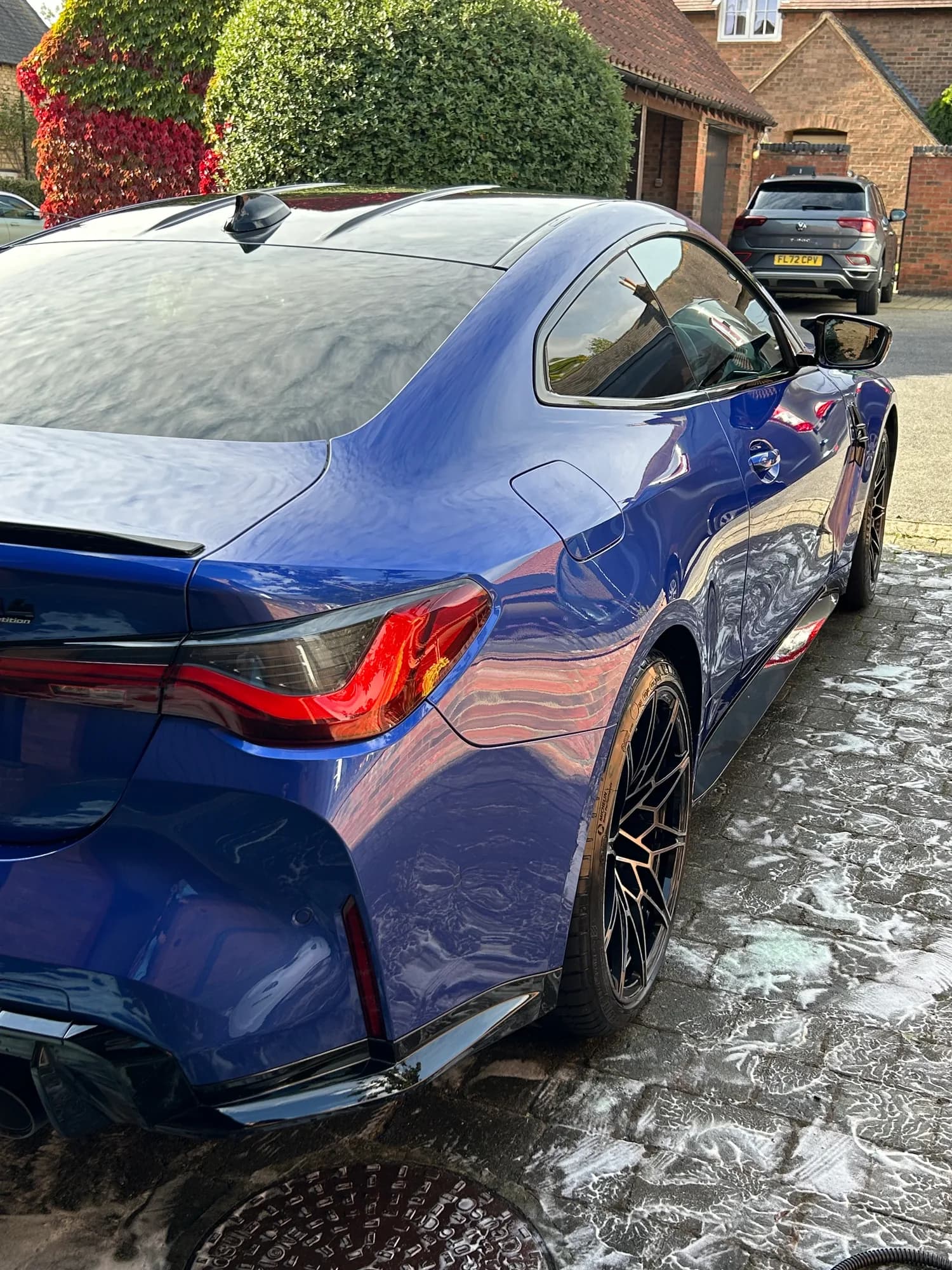
You walk up to the car on a bright morning and the paint looks like it has a spiderweb over it. Fine circular scratches, all over the bonnet, catching the light. Move into the shade and they vanish. Come back in sun and they're there again.
Those are swirl marks, and almost every car on the road has them. Here's what they actually are, why the usual fixes don't work, and what does.
They're scratches, not dirt
Your paint has a clear layer on top called the clear coat. It's what makes paint look glossy — it's transparent, so light passes through it, hits the colour underneath, and comes back to your eye cleanly.
Swirl marks are thousands of microscopic scratches in that clear layer. Each one is far too small to see on its own. But when direct light hits the panel, every scratch scatters a bit of it in a different direction, and collectively they show up as that hazy web.
This is also why they only appear in the sun. Diffuse light on a cloudy day hits the panel from every angle at once and the scattering isn't visible. Direct light comes from one point, so the scattering has somewhere to show.
The quick test
Put your phone torch against the paint in a dark garage. If you see a web of fine lines radiating out from the light, that's swirling. It's the same reason they show under petrol station canopies at night.
Where they come from
Almost always from washing and drying. Specifically:
- Automatic car washes. The brushes hold grit from every car that went through before yours, and drag it across your paint at speed. A single pass can undo a full correction.
- Sponges. A sponge has a flat face that traps dirt against the paint rather than lifting it away. Every wipe grinds that grit along the panel.
- One bucket. Rinse the mitt in the same water you're washing from and you're reapplying the dirt you just removed.
- Drying towels. Even good microfibre scratches if the panel isn't properly clean first, or if the towel has been dropped and picked up.
- Dry wiping. Taking bird mess or dust off a dry panel with a cloth. Guaranteed scratches every time.
None of these do visible damage on the day. That's exactly why swirls creep up on people. One wash adds a handful of scratches you'd never notice. Three years of washing adds a layer you can't miss.
And it starts earlier than most people expect. A lot of new cars are already swirled at handover, from the wash and prep they get at the dealership before you collect them.
Why polish from a tin doesn't fix it
Most off-the-shelf products aimed at swirl marks are glazes or fillers. They contain oils and waxes that sit down inside the scratches, making them level with the surrounding surface so light stops scattering. The car looks genuinely better.
The problem is that the fillers wash out. Two or three washes, a spell of rain, and the scratches are back, because they were never removed — just temporarily hidden. If you've ever wondered why the improvement faded after a month, that's why.
The scratch either gets removed or it gets covered up. Everything else is marketing.
What actually removes them
Machine polishing, also called paint correction. A machine polisher and an abrasive compound take a very fine layer off the top of the clear coat — enough that the bottom of each scratch is now the surface. The scratch isn't filled. There's nothing left of it.
That's a permanent fix in the sense that those particular scratches will never come back. New ones will, if the car goes back to being washed the same way, which is the part people miss.
How much comes out depends on how far you go. A single-stage correction typically removes 60–70% of swirling and makes a big difference to gloss. A two-stage removes 90%+ and gets very close to flawless. Deeper scratches — ones you can catch a fingernail in — go through the clear coat entirely and can't be polished out at any stage.
The catch: your clear coat is finite
Clear coat on a modern car is roughly 40 to 50 microns thick. A sheet of copier paper is about 100. You are working with half a sheet of paper, and it does not grow back.
A correction removes a few microns. Done properly, a car can take several over its life. Done badly — too aggressive a pad, too much heat, too many passes in one spot — you go through to the colour underneath, and the fix is a respray of that panel.
This is why paint depth gets measured before anything touches the car, and why the cheapest quote isn't always the cheapest outcome.
Stopping them coming back
Correction resets the paint. It doesn't change what caused the damage. Without changing the wash routine, a corrected car is visibly swirled again inside a year or two.
Two things prevent that. First, safer washing: two buckets, a proper mitt rather than a sponge, no automatic washes, and drying with filtered air or a plush towel on a genuinely clean panel. Second, a ceramic coating, which puts a hard sacrificial layer on top of the clear coat so the abuse lands there instead of on your paint.
That combination is why a coated car maintained properly still looks sharp at three years, and an uncoated one washed at the supermarket doesn't.
So is it worth correcting?
If the car is a few years old and you've never had it done, it's the single biggest visual change you can make to it — bigger than new wheels, bigger than a full valet. Most people are genuinely surprised by the before and after.
If the car is new, a lighter enhancement plus a coating locks the paint in near its best before the damage accumulates, which is cheaper than correcting it later.
If you're not sure which your car needs, send a photo taken in direct sunlight. That's usually enough to tell. Details on what's involved are on the paint correction and ceramic coating page.
Want a straight answer on your car?
Tell us what you've got and send a photo in daylight. You'll get pricing back the same day, and an honest view of what it actually needs.
Or call 07787 927204 — Mon–Sat, 8am–6pm